Best heat pump brands for Ontario winters
No brand is best at -25°C across its whole lineup; individual models are. Judge a heat pump by its reported capacity in deep cold and by the installer's cold-climate experience, then compare brands. Typical Ontario installed prices: $3,500 to $6,500 for a single-zone mini-split and $9,000 to $18,000 for a ducted cold-climate system, before HST.
Heat pump prices in Ontario, any brand
Heats and cools$3,500to$20,000
Typical installed price, Ontario 2026, all options shown
- Ductless mini-split, single zoneone indoor head $3,500 to $6,500
- Ductless mini-split, multi-zone3 to 5 indoor heads $9,000 to $18,000
- Cold-climate heat pump, ductedwhole home, air source $9,000 to $18,000
- Dual fuel systemheat pump with gas furnace backup $11,000 to $20,000
Installed price in Ontario, before 13% HST ($3,955 to $22,600 with HST). Standard replacement in a detached home with usable ductwork and venting.
On this page
What makes a heat pump cold-climate
Every air-source heat pump loses capacity as the outdoor air gets colder, because there is less heat in it to move. A cold-climate model keeps enough capacity and efficiency through an Ontario January to carry most or all of your heating. Four things separate one from a standard unit.
Capacity at low temperatures
The nameplate size, such as a 3-ton unit, describes output in mild weather. What matters is the maximum heating output at -15°C and colder, compared with your home's heat loss at its design temperature. Heating systems in most of Southern Ontario are designed for winter lows of around -20°C, and colder in Ottawa and the north.
A variable-speed inverter compressor
Inverter compressors speed up in cold weather and slow down in mild weather instead of cycling on and off. Nearly every cold-climate model uses one. A single-speed heat pump is a poor match for an Ontario winter.
Efficiency in the cold
COP (coefficient of performance) is heat delivered divided by electricity used: a COP of 2 means two units of heat for each unit of electricity. Products on NEEP's cold-climate list must report a COP of at least 1.75 at -15°C (5°F) at maximum output, and they run at much higher COPs in mild weather.
Defrost and snow
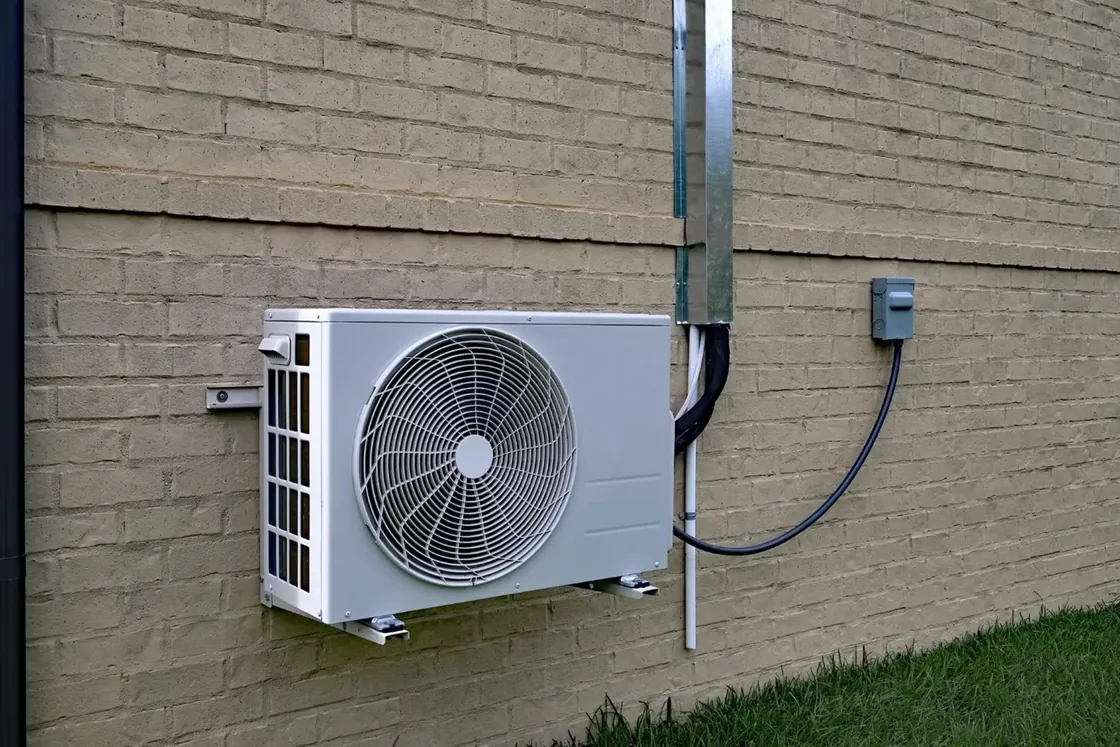
Outdoor coils frost up in damp cold, so the unit runs short defrost cycles. A good installation raises the outdoor unit on a stand or wall bracket above typical snow depth, away from roof drip lines, with a clear path for meltwater so it does not refreeze into a block of ice underneath.
Check the model, not just the brand
Every brand below sells both cold-climate and standard models, so the brand name tells you little. Check the exact combination you are quoted, then hold its price against the heat pump rows on the Ontario Furnace Prices price index.
Get the full model numbers
Ask for the outdoor unit and the indoor unit or coil model numbers. Heat pump ratings apply to a matched pair, not to the outdoor unit alone.
Look the pair up on the NEEP list
NEEP's cold-climate list shows manufacturer-reported heating capacity and COP at 8.3°C, -8.3°C and -15°C (47°F, 17°F and 5°F) for each listed combination. Compare the maximum capacity at -15°C with your home's heat loss.
Confirm rebate eligibility before you buy
The Home Renovation Savings Program requires the exact product to be eligible and requires pre-approval before installation. Its heat pump amounts are based on rated heating capacity at 8.3°C (47°F). Get approval first, then install.
Ask how the system was sized
For heating, a heat pump should be sized from a heat loss calculation, not copied from the tonnage of the old air conditioner.
Where to check
- Home Renovation Savings: heat pumps eligible products, pre-approval rules; checked October 4, 2026
- Home Renovation Savings: terms and requirements checked October 4, 2026
- NEEP cold-climate air-source heat pump list manufacturer-reported performance data
Programs change
Rebate rules, eligible products and amounts change. Confirm the current terms with the program and get pre-approval before you sign. Our Ontario heat pump rebates guide explains the rules as of October 4, 2026.
Heat pump or gas: what COP means for your bill
At typical Ontario all-in prices, about $0.50 per m3 of gas and $0.15 per kWh of electricity, a 96% furnace delivers heat for about 5.0 cents per kWh. A heat pump matches that at a COP of about 3.0: above it, the heat pump is cheaper to run; below it, gas is. Try your own rates and a COP from the NEEP list.
Heat pump or gas: cost per unit of heat
Estimates update as you change the inputs. Nothing is sent anywhere.
Break-even heat pump COP
Above this COP, the heat pump is cheaper to run than a 96% furnace.
Cost per 100 kWh of heat delivered
- Gas furnace$5.03
- Heat pump at COP 2.5$6.00
- Electric baseboard$15.00
Get the real number for your home: a free, no-obligation quote.
Planning comparison only: energy cost per unit of heat, ignoring fixed monthly charges, duct losses and defrost cycles. For a yearly estimate, use the heating cost calculator.
This is why many gas-heated Ontario homes choose dual fuel: the heat pump carries the mild months and the furnace takes over in deep cold. In a home heated by electric baseboard, any COP above 1 is a saving. For a full-year estimate with your home's size, use the heating cost calculator.
Widely sold heat pump brands in Ontario
These brands appear on many Ontario heat pump quotes. The list is alphabetical and is not a ranking: the model and the installer matter more than the name on the cabinet.
| Brand | Mostly quoted as | Worth knowing |
|---|---|---|
| Bosch | Ducted inverter heat pumps; ductless | Often added beside an existing gas furnace as a dual fuel retrofit |
| Carrier | Ducted central systems; ductless | Related to Bryant and Payne; often paired with Carrier furnaces |
| Daikin | Ductless and ducted inverter systems | Parent company of Goodman |
| Fujitsu | Ductless wall units and multi-zone | XLTH is the name on its extra-low-temperature models |
| LG | Ductless and multi-zone systems | Ask specifically for its cold-climate models |
| Lennox | Ducted central systems | Sold through Lennox dealers; often paired with Lennox furnaces |
| Mitsubishi Electric | Ductless and ducted inverter systems | Hyper-Heat is its cold-climate line |
| Samsung | Ductless and multi-zone systems | Ask specifically for its cold-climate models |
| Trane | Ducted central systems | Sister brand of American Standard; often paired with Trane furnaces |
Brands named for reference only. Listing is alphabetical and implies no ranking or endorsement.
Heat pump price tiers in Ontario
Brand moves a heat pump quote less than the system type, the number of indoor heads and the electrical work. Within each type, these bands are typical.
| System | Value | Mid | Upper |
|---|---|---|---|
| Ductless, single zone | $3,500 to $4,500 | $4,000 to $5,500 | $5,000 to $6,500 |
| Ductless, 3 to 5 zones | $9,000 to $12,000 | $11,000 to $15,000 | $14,000 to $18,000 |
| Ducted cold-climate | $9,000 to $12,000 | $11,500 to $15,000 | $14,000 to $18,000 |
| Dual fuel with gas furnace | $11,000 to $14,000 | $13,000 to $17,000 | $16,000 to $20,000 |
Before 13% HST, inside our provincial ranges (single zone $3,500 to $6,500, multi-zone $9,000 to $18,000, ducted $9,000 to $18,000, dual fuel $11,000 to $20,000). The upper band usually means a top cold-climate line, larger capacity or a harder install.
- Electrical work for a heat pump$500 to $2,500
- Electrical panel upgrade$2,000 to $4,500
- Ductwork modifications$500 to $3,000+
- New thermostat$150 to $600
- Municipal permit$75 to $300
Installer experience matters more with heat pumps
An oversized furnace still heats the house. A heat pump sized for cooling alone, buried by snow or set to switch over at the wrong temperature costs you every winter. Ask how many cold-climate systems the contractor installed last season and listen for specifics on these points.
- Sizing from a CSA F280 heat loss calculation, with the heat pump's output at your design temperature shown in writing.
- For dual fuel, the outdoor temperature at which the system hands over to the furnace, and how it was chosen for your gas and electricity rates.
- The outdoor unit on a stand or bracket above typical snow depth, clear of roof drip lines, with drainage for defrost meltwater.
- Refrigerant lines pressure-tested and evacuated, with the readings recorded at commissioning.
- Electrical capacity checked before you sign: some homes need a new circuit or a panel upgrade.
- Rebate paperwork in the right order: pre-approval first, installation second.
Warranty registration
Most heat pump makers offer a limited parts and compressor warranty, commonly 10 years or longer, that depends on registering the equipment soon after installation. Labour is usually the installer's warranty, not the manufacturer's. Ask for the certificate for your exact model, register it, and keep the commissioning record and invoice with your rebate paperwork. Our heat pump buying guide covers the rest of the purchase, and the heat pump price guide breaks down every cost line.
Get a heat pump quote sized for your winter
A free in-home estimate checks heat loss, ductwork and electrical capacity, then prices a cold-climate system that fits your home.
Free, no obligation. About a minute to request.
Questions people ask
Which heat pump brand works best in Canadian winters?
No single brand. Most major brands sell cold-climate models and standard models side by side, and the difference between those two is far bigger than the difference between brands. Look up the exact outdoor and indoor model pair on the NEEP list, compare its capacity at -15°C with your heat loss, and choose an installer who sets these systems up every winter.
Will a heat pump keep my house warm at -25°C?
Many cold-climate models are rated to keep running at -25°C or colder, but their output at that temperature is well below their mild-weather output. Whether that covers your house depends on its heat loss. Most gas-heated homes keep the furnace as backup in a dual fuel setup, and all-electric homes usually add electric backup heat.
Does the brand affect the Ontario heat pump rebate?
Eligibility depends on the exact product, not the brand, plus your home, your heating fuel and pre-approval before installation. Replacing an existing heat pump used for space heating is excluded. Amounts follow the program's current rules, so confirm them with the program before you buy. Our heat pump rebates guide has the details.
Do I need to keep my gas furnace?
Not always. If the heat pump's output at your design temperature covers your heat loss, it can heat on its own with electric backup. Many Ontario homes keep a working furnace for dual fuel, because gas is cheaper per unit of heat in deep cold at typical rates. Dual fuel systems typically cost $11,000 to $20,000 installed when the furnace is replaced too.
Why do quotes for the same brand vary so much?
The same brand sells standard and cold-climate models at different prices, in different capacities, and quotes differ on electrical work, line set length, ductwork changes and thermostats. Dealer labour rates vary too. Ask every contractor for the model numbers and a line-by-line scope so you can compare like with like.