AC size calculator
Most Southern Ontario homes need about 1 ton of cooling per 500 to 700 sq ft, so a 1,800 sq ft house usually points to a 3 ton air conditioner (36,000 BTU/h). Enter your home for a planning range, then confirm it with a CSA F280 load calculation.
Estimate your air conditioner size
Estimates update as you change the inputs. Nothing is sent anywhere.
Estimated cooling size
Rule of thumb for Southern Ontario
- Cooling capacity31,000 to 43,000 BTU/h
- Standard sizes in range3 or 3.5 ton
- Closest to the middle3 ton
- Airflow it needs1,050 to 1,200 CFM
- Adjustment to the base ruleNo change
A 3 ton system needs about 1,050 to 1,200 CFM of airflow. Check that your furnace blower and return ducts can carry it before choosing a bigger size.
Get the real number for your home: a free, no-obligation quote.
Rule of thumb only: A CSA F280 room-by-room load calculation is the proper sizing method in Canada. Use this range to check that a quoted size is reasonable, not to choose equipment.
On this page
AC size chart for Southern Ontario
The chart runs the rule of thumb in reverse: the floor area each standard size usually covers before any adjustment for sun, insulation or ceilings. The rows overlap, which is why two neighbouring sizes often both look right.
| Size | Cooling capacity | Floor area it usually covers | Airflow needed |
|---|---|---|---|
| 1.5 ton | 18,000 BTU/h | 750 to 1,050 sq ft | 525 to 600 CFM |
| 2 ton | 24,000 BTU/h | 1,000 to 1,400 sq ft | 700 to 800 CFM |
| 2.5 ton | 30,000 BTU/h | 1,250 to 1,750 sq ft | 875 to 1,000 CFM |
| 3 ton | 36,000 BTU/h | 1,500 to 2,100 sq ft | 1,050 to 1,200 CFM |
| 3.5 ton | 42,000 BTU/h | 1,750 to 2,450 sq ft | 1,225 to 1,400 CFM |
| 4 ton | 48,000 BTU/h | 2,000 to 2,800 sq ft | 1,400 to 1,600 CFM |
| 5 ton | 60,000 BTU/h | 2,500 to 3,500 sq ft | 1,750 to 2,000 CFM |
Rule of thumb: 1 ton per 500 to 700 sq ft of cooled space, 12,000 BTU/h per ton, 350 to 400 CFM per ton. Five tons is the largest common residential size.
For what these sizes cost, see air conditioner prices: a standard 1.5 to 3 ton central AC typically runs $3,800 to $7,000 installed before HST, and high-efficiency variable-speed systems $6,500 to $10,500. The Ontario Furnace Prices index sets both beside every other system on one scale.
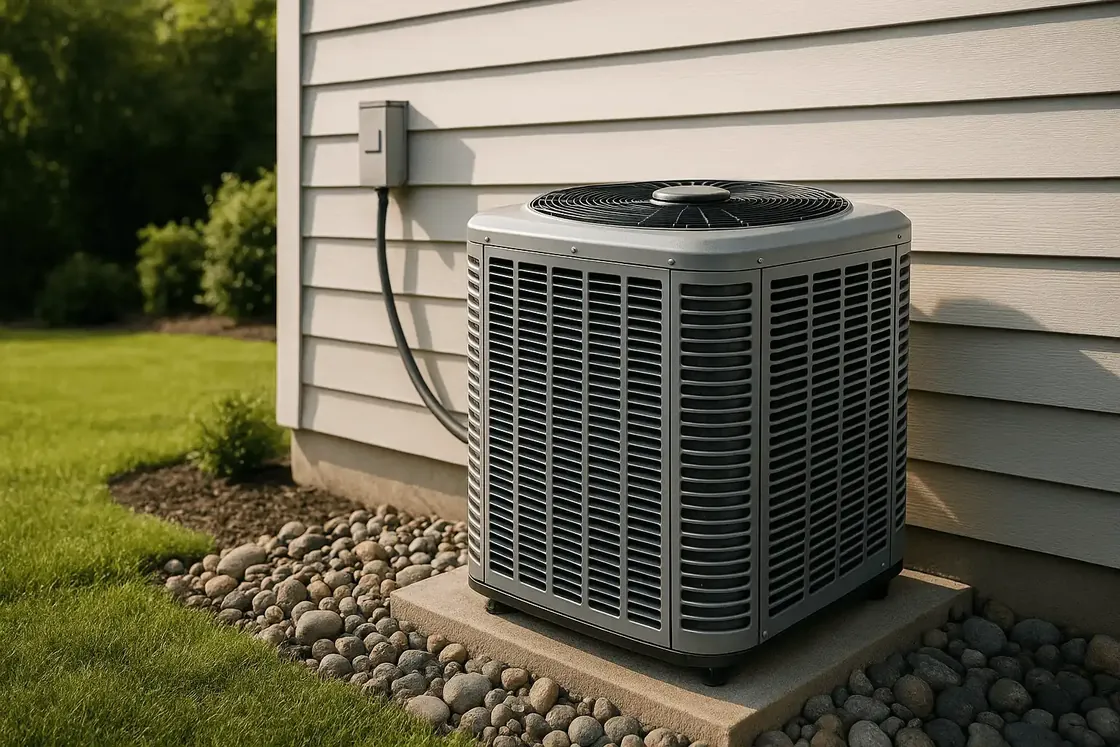
How the calculator adjusts the rule
The base rule gives a range from your floor area. Each answer then raises or lowers the cooling load, and the calculator multiplies the adjustments together.
| Input | Lowers the load | Raises the load |
|---|---|---|
| Sun on the house | Mostly shaded: −8% | Lots of west or south glass: +10% |
| Insulation and windows | Good: −10% | Poor: +12% |
| Ceiling height | None | 9 ft: +5%, over 9 ft: +10% |
| Hot rooms under the roof | None | Yes: +7% |
Average sun, average insulation and 8 ft ceilings leave the rule unchanged.
These percentages are our own planning adjustments, set to show direction and rough size. A load calculation replaces every one of them with measurements of your windows, walls, attic insulation and air leakage. West-facing glass matters most because it takes the late afternoon sun during the hottest part of the day.
Why an oversized AC leaves the house clammy
An air conditioner dries the air as well as cooling it. Moisture condenses on the cold indoor coil and drains away, but only once the coil has run long enough to get cold and wet. An oversized unit reaches the thermostat setting in short bursts, so a large share of each run happens before it removes much water. The house hits 22°C and still feels sticky.
Oversized: many short runs
Right-sized: fewer, longer runs
Cooling while the coil gets cold Cooling and drying the air Off
Short cycles also mean more starts, which wear the compressor and contactor, bigger temperature swings, and a higher price for capacity you never use. Two-stage and variable-speed units ease the problem by running at low output most of the time.
A free fix for a clammy house
Set the furnace fan to auto in summer. With the fan running all the time, water left on the coil after each cycle evaporates back into the house.
Your ducts and furnace blower set the ceiling
Central AC rides on your furnace's blower and ductwork. Each ton needs roughly 350 to 400 CFM of airflow, so a 3 ton system needs about 1,050 to 1,200 CFM moving through the coil, the filter and the ducts. If the blower or ducts cannot carry that, a bigger outdoor unit will not cool better: expect noisy registers and a coil that can freeze up. A hot upstairs is usually an airflow problem, and a bigger AC rarely fixes it.
Before going up a size, check the furnace documentation for the largest AC its blower supports and ask whether the return ducts are big enough. If the furnace is near the end of its life, replacing furnace and AC together lets the installer match blower, coil and condenser in one job. The heating side has its own tool: the furnace size calculator.
Get a sized quote, not a guess
A participating local heating and cooling company can size the system from your actual home and put the price in writing.
Free, no obligation. About a minute to request.
Worked example: same house, a ton apart
Two 2,000 sq ft two-storey homes on the same street, both with 8 ft ceilings. House A has newer windows and an upgraded attic. House B has its original windows and a wall of west-facing glass.
| Detail | House A | House B |
|---|---|---|
| Sun on the house | Average | Lots of sun |
| Insulation and windows | Good | Poor |
| Adjustment to the rule | −10% | +23% |
| Estimated size | 2.6 to 3.6 tons | 3.5 to 4.9 tons |
| Cooling capacity | 31,000 to 43,000 BTU/h | 42,000 to 59,000 BTU/h |
| Closest standard size | 3 ton | 4 ton |
Same floor area, a full ton apart, from windows and sun alone. That is the gap a load calculation closes. If new windows or attic insulation are on your list, do them before sizing the AC, not after.
Get a real load calculation
In Canada the proper method is a CSA F280 room-by-room calculation. It uses your home's windows, orientation, insulation and air tightness with local design temperatures, and it sizes the furnace, AC or heat pump together. Read the air conditioner buying guide before you compare quotes, and bring these questions.
Questions to ask before you sign
- Will you do a CSA F280 load calculation, and can I keep a copy?
- What size is my current system, and why should the new one be the same or different?
- Can my furnace blower and ducts move the airflow this size needs?
- Is the indoor coil matched to the outdoor unit, with an AHRI certificate for the pair?
- Would a two-stage or variable-speed unit suit my house better than a bigger single-stage one?
Thinking about heating too? A heat pump is sized for the heating load, which in Ontario is usually larger than the cooling load. The heat pump cost calculator shows what that costs.
Questions people ask
What size AC do I need for a 2,000 sq ft house?
By the Southern Ontario rule of thumb, about 2.9 to 4 tons before adjustments, which points to a 3, 3.5 or 4 ton system, with 3.5 closest to the middle. Newer, well-insulated homes often land at the low end or below it, and older homes with lots of west-facing glass land higher. A load calculation decides, and the ducts must carry the airflow.
How many BTU is a 3 ton air conditioner?
36,000 BTU per hour. One ton of cooling is 12,000 BTU/h, roughly the rate of heat absorbed by melting a ton of ice over a day. So 1.5 tons is 18,000 BTU/h, 2.5 tons is 30,000 and 5 tons is 60,000, the largest common residential size. Model numbers often carry it: a 36 usually means 36,000 BTU/h.
Is it better to oversize or undersize an air conditioner?
Neither, but in humid Southern Ontario summers a slightly small system is usually more comfortable than an oversized one, because it runs longer and removes more moisture. A badly undersized unit falls behind on the hottest afternoons, though. If a load calculation lands between two sizes, a two-stage or variable-speed unit can cover both.
Should my new AC be the same size as the old one?
Not automatically. Many older systems were sized by rule of thumb, and homes change: new windows, attic insulation and air sealing all cut the cooling load. If the old unit ran in short bursts or the house felt clammy, it was probably oversized, and the new one can often be smaller.